

Contractor Lic. No. 940822 | Security Lic. No. ACO1290
© Copyright 2026 SEBASTIAN. All rights reserved.
| Quick Takeaway Primary Insight: Commercial access control installations fail inspection at the door, not at the panel. Egress release and accessibility requirements decide whether the system gets approved. Key Fact: An electrically locked egress door in California must unlock automatically on fire alarm activation, on loss of power, and from a “PUSH TO EXIT” device mounted within five feet of the door. Best Suited For: Facility managers, property owners, and business operators planning a new access control installation or expanding an existing one. |
The electronics are the easy part. Readers mount, controllers rack up, credentials enroll, and the software works roughly the way the demo suggested it would. Then the fire inspector arrives, pushes on a door, and the project stops.
Access control installation is regulated as life safety work, not as low voltage work. A door that locks is a door that can trap someone, so California building and fire codes govern exactly how an electrically locked door has to behave when the power fails, when the fire alarm sounds, and when someone simply walks up to it wanting to leave. Accessibility law governs how the reader and the hardware have to be reachable and operable.
None of that appears in a hardware quote. It appears at inspection, which is why the specification work that actually matters happens at the door long before anyone selects a panel.
Inspections fail over egress and accessibility, because those are the provisions with hard, testable requirements that an inspector can verify in thirty seconds by pushing on a door. Nothing about the credential technology, the software platform, or the panel brand is typically at issue.
Three failures account for most rejected installations. A lock that does not release when it should. A release device that is missing, mislocated, or wired through the access control system instead of directly interrupting power. A reader or lever mounted outside the reach and operating requirements of accessibility law.
Each of those is inexpensive to design correctly and expensive to correct after the fact, because correction usually means opening finished walls, re-pulling cable, and re-inspecting. Getting the door right on paper is the entire game.
Where a door in the means of egress is held locked by an electrified device released by a sensor, Chapter 10 of the California Fire Code requires the installation to satisfy a specific set of conditions. These are the provisions most commonly missed.
One nuance is worth understanding, because it is widely misread. These sensor release provisions apply to doors where a sensor releases the lock, which in practice usually means magnetic locks. They do not automatically apply to every door that happens to have a card reader on it. A door with an electric strike that retains free mechanical egress from the inside lever is a different application governed by different provisions.
That distinction changes the scope and cost of an installation substantially, and it is the first thing a competent designer establishes for each opening.
The single most consequential hardware decision at each door is what the lock does when power disappears, and the correct answer depends on whether the lock controls egress or merely controls entry.
| Consideration | Fail-safe | Fail-secure |
|---|---|---|
| Behavior on power loss | Lock releases and the door can be opened | Lock stays engaged and the door remains latched |
| Egress on power loss | Provided by the lock itself releasing | Must be provided mechanically by the inside lever or panic device |
| Typical application | Magnetic locks, and doors where the lock controls egress | Electric strikes on doors that keep free mechanical egress from inside |
| Security on power loss | Opening becomes unsecured | Opening stays secured |
| Fire alarm interface | Must release on alarm activation | Release depends on the door’s role in the means of egress |
Specifying fail-secure hardware on a door where the lock is the only thing standing between an occupant and the exit is a life safety failure. Specifying fail-safe hardware on a perimeter door with mechanical egress means the building unlocks itself during every power outage. Both errors are common, and both come from treating the choice as a preference rather than a function of the door’s role.
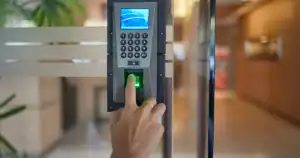
Card readers are operable parts under accessibility law, which means their mounting height is regulated rather than a matter of installer habit. The U.S. Access Board’s guidance on operable parts sets the unobstructed reach range at 15 inches minimum and 48 inches maximum above the floor, with the 48 inch maximum reduced to 44 inches where the reach passes over an obstruction deeper than 20 inches.
Door hardware carries its own requirements. Under the ADA Standards, operable parts must work with one hand without tight grasping, pinching, or twisting of the wrist, and must activate with no more than 5 pounds of force. Round knobs do not comply because they require twisting. Lever handles, push bars, and panic devices do.
Interior hinged doors on an accessible route are separately limited to 5 pounds of opening force. That limit interacts directly with access control hardware, because an electric strike or closer adjusted to overcome a stiff latch can push a door past the threshold. Verifying opening force after installation is a five-minute check with a gauge, and skipping it is a frequent source of accessibility complaints long after the inspector has signed off.
Access control installation timelines are usually driven by infrastructure rather than by devices, because every controlled opening needs power, network reach, cable pathway, and door preparation before a reader goes on the wall.
Each opening typically requires cable from the door to a controller location, low voltage power with battery backup sized to hold the system through an outage, and network connectivity for the controller. Doors that need a new electric strike also need the frame prepared, which on a hollow metal frame in an existing wall is a fabrication task rather than an installation task.
The fire alarm interface deserves particular attention, because it crosses trades. Releasing locks on alarm requires a supervised connection between the fire alarm panel and the locking system, and that connection has to be installed, programmed, and tested as part of the fire alarm system rather than bolted on afterward. Projects that treat access control and fire alarm as separate scopes frequently discover at commissioning that no one owns the interface.
Sebastian handles access control and security systems alongside fire alarm and low voltage cabling, which keeps that interface inside one scope instead of split across contractors who meet for the first time at inspection.
Commissioning verifies that every release path actually works, and it is the step that separates a system that passed inspection from a system that merely got installed. Each controlled door should be tested individually against every condition the code requires it to respond to.
A complete test at each opening means pulling power to the lock and confirming release, pulling power to the sensor and confirming release, operating the push-to-exit device and confirming a direct power interruption lasting at least 30 seconds, activating the fire alarm and confirming the door unlocks and stays unlocked until reset, and measuring door opening force with a gauge.
Document the results per door. When a jurisdiction returns for a re-inspection, or when a door misbehaves two years later, a commissioning record showing what was tested and what it did is the difference between a quick diagnosis and a building-wide investigation.
Motion sensors and push-to-exit devices are required on doors where an electrified lock is released by a sensor, which typically means magnetic locks on egress doors. A door using an electric strike that preserves free mechanical egress from the inside lever falls under different code provisions and generally does not require the sensor release arrangement. The determining factor is whether the lock controls egress, not whether the door has a reader.
Electrically locked egress doors must unlock automatically when the building fire alarm system activates, and they must remain unlocked until the alarm system is reset. The same requirement applies to activation of the sprinkler system or fire detection system where those are provided. This release must be a supervised interface between the fire alarm panel and the locking system.
Magnetic locks are allowed on commercial egress doors in California when the installation meets every condition in the applicable Chapter 10 provisions, including sensor release, release on loss of power, a signed push-to-exit device within five feet of the door, fire alarm release, emergency lighting on the egress side, and UL 294 listing. Magnetic locks installed without that full arrangement are a common inspection failure.
Card readers should be mounted within the accessible reach range of 15 to 48 inches above the finished floor, because readers qualify as operable parts under the ADA Standards. Where the reader is reached over an obstruction deeper than 20 inches, the maximum drops to 44 inches. Mounting a reader above 48 inches is one of the more frequent accessibility corrections issued on otherwise complete installations.
Permits are generally required for commercial access control installation because the work involves electrified door hardware in the means of egress, low voltage wiring, and in most cases a fire alarm interface. Requirements and plan review expectations vary by jurisdiction, so confirm scope with the local building department and fire authority before work begins rather than after.
Access control projects go wrong in a predictable order. The system gets selected, the doors get counted, the hardware gets ordered, and only then does anyone ask what each opening is required to do during a power failure or an alarm. By that point the answers cost money.
Reversing the order fixes almost everything. Establish each door’s role in egress first, choose fail-safe or fail-secure from that role, confirm reach and operating force for the hardware and reader, and identify which openings need a fire alarm interface. The system selection follows easily once those decisions exist. If you want the background on choosing a platform, our guide to how door access control systems work covers credentials, permissions, and integration.
Sebastian designs and installs commercial access control across the Central Valley in schools, government facilities, agricultural operations, and industrial sites where egress and inspection requirements are not negotiable. Request a proposal and we can walk your openings before anything gets ordered.


Contractor Lic. No. 940822 | Security Lic. No. ACO1290