

Contractor Lic. No. 940822 | Security Lic. No. ACO1290
© Copyright 2026 SEBASTIAN. All rights reserved.
Most access control systems cost several thousand dollars more or less than a business expects, even for what looks, on paper, like the same project. That is not a sign of inconsistent pricing. Commercial access control cost is driven by a handful of specific variables, door count, credential type, cloud versus on-premise management, and how much of the existing security stack a new system has to integrate with, and two buildings that look similar on the outside can land in very different price ranges once those variables are accounted for.
Fresno businesses researching access control tend to get informational answers about how the technology works, but not much that helps them evaluate an actual quote or compare vendors on anything other than price. That gap matters, because the difference between a fair quote and an inflated one is almost always hidden in which of these cost drivers a vendor is quietly building in or leaving out.
This guide breaks down what actually drives commercial access control cost, compares the main credential options businesses choose between, and explains what changes when a system is a retrofit into an older building instead of a new install. The goal is to leave you able to read a quote critically, not just accept the number at the bottom.
QUICK TAKEAWAY:
Primary Insight: Access control systems cost is driven far more by door count, credential type, and integration complexity than by the access control panel or software itself, so two quotes for “the same system” can differ significantly once those variables are compared line by line.
Key Fact: UL 294 defines four performance levels for access control system units, from basic (Level I) to high-security equipment (Level IV), and the level a building actually needs is one of the biggest hidden cost levers in a quote.
Best Suited For: Fresno business owners and facilities managers comparing access control quotes or deciding between a system upgrade and a full retrofit.
Access control systems cost comes down to four variables: how many doors are covered, what type of credential is used, whether the system is cloud-managed or on-premise, and how much it needs to integrate with an existing security or building system. Buyers requesting quotes for commercial door access control systems are often surprised at how much these four variables move the price. A quote that does not break these out clearly is harder to compare against a competing bid.
Door count is the most obvious driver, but not in a simple per-door multiplication. Each controlled door needs its own reader, controller wiring, and often an electric strike or maglock, and the labor to run wiring to a door in an existing building varies enormously depending on ceiling type, wall construction, and how far that door sits from the nearest electrical or network closet. A five-door system in an open-plan office with accessible ceilings costs meaningfully less per door than a five-door system spread across a building with finished ceilings and concrete walls.
Credential type is a bigger lever than most buyers expect, covered in detail in the next section, since the gap between a basic key fob system and a biometric one is not incremental.
Cloud-managed systems typically carry a recurring software fee in exchange for remote management, automatic updates, and the ability to add or revoke credentials without being on-site. On-premise systems shift more of the cost to upfront hardware and IT infrastructure, with no recurring software fee, but require a server on-site and IT support to maintain it. Neither is categorically cheaper. The right answer depends on whether a business already has IT staff and infrastructure to support an on-premise system, or would rather trade a recurring fee for remote access and less internal maintenance burden.
Integration is the variable most often underestimated in a quote. A system that has to talk to an existing camera system, a fire alarm panel, or a separate building automation system takes meaningfully more engineering time than a standalone install, and a quote that does not account for that integration work up front tends to grow once installation actually starts.
The four common credential types, key fobs, card readers, mobile credentials, and biometrics, sit on a spectrum from lowest to highest cost, and the right choice depends more on the building’s risk profile and user turnover than on budget alone.
Comparison: access control credential types
| Credential Type | Relative Cost | Best Suited For | Trade-Off to Know |
|---|---|---|---|
| Key fobs / proximity cards | Lowest | Small offices, retail, low-turnover staff | Cheap to deploy but easy to lose, share, or clone with basic equipment |
| Card readers (badge-based) | Low to moderate | Multi-tenant offices, businesses that already issue ID badges | Familiar to manage but still a physical credential that can be lost or shared |
| Mobile credentials | Moderate | Businesses with high staff turnover or multiple sites | No physical card to reissue, but depends on staff having a working smartphone |
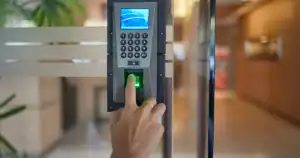
| Biometrics | Highest | Server rooms, high-security or regulated spaces | Strongest identity assurance, but the highest hardware cost and the most sensitive to privacy and data-handling questions |
A building rarely needs the same credential type at every door. A common, cost-effective pattern is key fobs or badges at general entry points, with mobile credentials or biometrics reserved for a smaller number of higher-sensitivity doors, like a server room or a records room, rather than upgrading every door in the building to the highest tier.
A retrofit into an existing building almost always costs more per door than the same system specified during new construction, because retrofit work has to route wiring through walls, ceilings, and conduit that were never designed to carry it. New construction can plan for access control from the electrical rough-in stage, which avoids most of that added labor entirely.
A system replacement project, swapping an aging or unsupported access control system for a current one, has its own cost profile. Existing wiring and door hardware can often be reused if it is in good condition and compatible with the new panel, which meaningfully lowers the cost compared to a full retrofit. The real cost driver in a replacement project is usually the panel and software migration, not the physical door hardware, since credentials, schedules, and user permissions all have to be rebuilt in the new system rather than simply carried over.
Buildings undergoing a broader renovation or a new tenant improvement are in the best position to add or upgrade access control cost-effectively, since the walls are already open and the electrical contractor is already on-site. Businesses planning a remodel should raise access control with their contractor early, before walls close back up, rather than treating it as a separate project afterward.
Access control projects in the Fresno area span a wide range of building types, and the right system looks different for each one. Multi-tenant office buildings typically need centralized, cloud-managed systems that let property management issue and revoke credentials across multiple businesses without an on-site visit. Industrial and agricultural sites often need a smaller number of hardened doors covering equipment or chemical storage, paired with more basic access at general entry points. New construction projects have the advantage of specifying access control before walls close, which keeps per-door cost lower than a comparable retrofit.
System replacement projects, upgrading an aging access control system that is no longer supported or that a business has simply outgrown, are one of the most common access control requests Sebastian Corp sees in the Fresno area, since many commercial buildings installed their original systems well over a decade ago. Business security cameras are frequently part of the same conversation, since cameras and access control share overlapping infrastructure and are often specified together rather than as separate projects.
Commercial access control cost depends primarily on door count, credential type, whether the system is cloud-managed or on-premise, and integration complexity, which is why two systems that look similar on paper can carry very different price tags. An accurate number requires a site walk-through rather than a flat per-door estimate, since wiring conditions and integration needs vary building to building.
Cloud-based and on-premise access control shift cost to different places rather than one being categorically cheaper. Cloud systems typically carry a recurring software fee in exchange for remote management and easier credential updates, while on-premise systems avoid the recurring fee but require more upfront IT infrastructure and internal maintenance.
Key fobs cost less to deploy initially but carry an ongoing cost of reissuing lost or unreturned cards, especially in businesses with high staff turnover. Mobile credentials cost more per user upfront but eliminate physical card reissuance, which can offset the higher initial cost over time in a business with frequent staff changes.
Retrofitting an older building with access control typically costs more per door than a comparable new-construction install, since wiring has to be routed through existing walls, ceilings, and conduit rather than planned into the electrical rough-in. The exact cost depends heavily on ceiling type, wall construction, and how far each door sits from the nearest electrical infrastructure.
Access control and camera systems do not share core hardware, but they do share network infrastructure and are frequently specified together during the same project. Businesses planning an access control upgrade often find it more cost-effective to evaluate cameras at the same time rather than as a separate project later.
None of the cost drivers above can be priced accurately without seeing the actual building, which is exactly why a firm number requires a site walk-through rather than a phone estimate.
Sebastian Corp handles access control and security alongside fire and life safety systems, which means a single site visit can scope both a new access control system and any overlapping fire and life safety needs in one conversation rather than two. For businesses weighing a full system replacement against a more limited upgrade, How Door Access Control Systems Work is a useful primer on the underlying technology, and Access Control Installation & Code Requirements For Inspections covers what an inspector will check once the system is in.
Ready to see what access control would actually cost for your building? Contact Sebastian Corp to schedule a site walk-through and get a quote based on your specific doors, not a generic estimate.


Contractor Lic. No. 940822 | Security Lic. No. ACO1290