


Contractor Lic. No. 940822 | Security Lic. No. ACO1290
© Copyright 2026 SEBASTIAN. All rights reserved.
Quick Takeaway Primary Insight: The right method for underground conduit installation depends on what sits on the surface, what is already buried, and the schedule, so neither directional boring nor open trenching wins on every site.
Key Fact: California excavators must request utility marking through 811 with at least two working days’ notice before digging, whichever method is used.
Best Suited For: Owners, general contractors, and public agency project managers who need power or communications cable run underground across a site, under pavement, or beneath a road.
Directional boring often gets described as the modern answer and open trenching as the old one. Real sites are less tidy. Underground conduit installation is a series of decisions about one route, and the simpler method changes with every parking lot, landscaped strip, and buried pipe in the way.
Underground conduit installation means placing buried pipe so electrical, fiber, or communications cable can be pulled through it later. A well-planned route protects the cable and lets future cables go in without digging the same ground again.
This guide covers what the work involves, how trenching and directional boring each work, how to choose between them, what has to happen before anyone digs, and how underground work fits the rest of a project.
Underground conduit installation places a buried raceway between two points, such as a utility connection and a building, or one building and another, so cables can be pulled through afterward. The cable can be electrical feeders, fiber, or communications lines, and the conduit gives each a protected, serviceable pathway.
Pull boxes, manholes, and vaults are added along the route where cables need access or the path changes direction. Sebastian’s underground contracting page lists conduit systems for electrical and communication cables, horizontal directional drilling, utility boring, and precast manholes and custom vaults among its underground services.
The route is chosen first, and the installation method follows from it. Adding spare conduit while the ground is already open is a common planning step, because reopening the same route later means repeating the excavation.
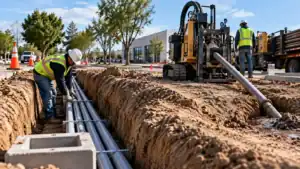
Open trenching excavates a continuous trench along the route, places the conduit in it, and backfills the ground above. The method fits open ground where nothing sits on the surface: new building pads, undeveloped sites, landscaped areas, and long runs along clear corridors.
The strengths are visibility and flexibility. The whole route is open to inspection, buried obstacles are exposed as they are found, and extra conduits, spare runs, and pull boxes are simple to add along the way.
The costs show up on the surface and in safety. A Purdue University and Indiana DOT report prepared with the Federal Highway Administration lists the drawbacks of open-cut work as health and safety concerns of workers, surface disturbance, and disruption to vehicle and pedestrian traffic. Cal/OSHA’s excavation guidance calls for protective systems such as shoring or sloping in trenches deeper than 5 feet and in shallower trenches where a competent person sees a cave-in risk, with that competent person inspecting the excavation daily.
Horizontal directional drilling, or HDD, installs conduit along a steered underground path drilled from the surface, so most of the route stays undisturbed. The work moves in three stages: a small pilot bore is drilled along the planned path and tracked electronically, the bore is enlarged to a size larger than the pipe, and the conduit is pulled back through the opened bore.
The same Purdue and INDOT report calls steering capability the major advantage of HDD and notes that drilling from the surface means no vertical shafts are required for drive and reception pits. That is why HDD suits routes under roads, driveways, sidewalks, existing buildings, and finished landscaping. Sebastian’s underground page describes utility boring for congested areas and HDD for pipes, conduits, and cables.
Ground conditions set the limits. The report describes clay as ideal for HDD, notes that steering accuracy can suffer in gravel or soft rock, and points out that the product pipe must have enough tensile strength to survive the pullback. Electronic tracking can also be limited by geology and by interference from overhead power lines. A soil investigation and a record of existing utilities belong before the method is chosen, not after.
Directional boring suits routes where the surface cannot be opened, and open trenching suits routes where the ground is clear and the pathway needs to stay accessible. The table compares the two on the factors that usually decide the choice.
| Factor | Open trenching | Directional boring (HDD) |
|---|---|---|
| Surface disruption | A continuous strip of ground is opened along the whole route | Disturbance is concentrated at entry and exit points and any connection pits |
| Restoration | Backfill, compaction, and repaving or replanting along the route | Restoration is limited to the entry and exit areas |
| Buried obstacles | Exposed and visible as the trench advances | Steered around, which depends on knowing what is there before drilling |
| Soil and ground | Workable in most soils with shoring where needed | Soil affects steering and bore stability; gravel and soft rock are harder |
| Extra conduits and pull boxes | Simple to add along the open route | Planned in advance; added runs may need additional bores |
| Worker exposure | Crews work in or beside an open excavation | Less work takes place inside open excavations |
The advantage of boring depends on the site rather than the label. A published field comparison in Oklahoma, Evaluating Benefits of Horizontal Directional Drilling Compared to Open-Cut, found the two methods comparable on equipment emissions and found no evidence that HDD reduced traffic disruption at the project it studied. A route across an open lot can favor the trench; a route under a busy drive aisle can favor the bore.
A horizontal directional drilling contractor should be able to explain the plan before the first bore is drilled. Four questions cover most of the risk:
California law requires anyone excavating to request utility marking through 811 before digging, and the request needs at least two working days’ notice. USA North 811 states that calling is required by law in California and Nevada, and the California Dig Safe Board oversees safe excavation around buried utilities.
Three details catch project teams off guard. Each excavating company needs its own ticket, so a subcontractor cannot work under another contractor’s request. Private lines are not marked because utility members mark only the facilities they own, which means site lighting feeders, irrigation, and other on-site lines need as-built drawings or private locating. Within the marked tolerance zone, excavation is limited to human-powered hand tools.
Cal/OSHA’s excavation guidance adds employer duties: notify the regional notification center at least two working days and no more than 14 calendar days before the start date, use a qualified person for locating, and verify exact locations with safe methods such as hand tools as digging approaches. The same guidance notes that excavations 5 feet or deeper that a person may enter generally require a Cal/OSHA permit. Work in a public street or right-of-way usually brings a local agency permit as well, so the permitting path should be confirmed with the city or county for each site.
Underground conduit sits at the front of the construction sequence, so its route, depth, and building stub-ups must be settled before paving, slabs, and landscaping close the ground. A conduit that misses a stub-up location or crosses a future building footprint becomes a change order.
Coordination covers more than the conduit itself. Electrical service, site lighting, communications, and fiber often share a route, which makes pull-box locations, vault placement, and spare capacity a joint decision for the electrical, low voltage, and underground scopes. Sebastian’s construction and low voltage services sit alongside underground contracting for that reason.
Sebastian’s project pages show this work on both private and public sites:
Public agency projects add their own review and inspection steps. Sebastian’s government page outlines the public works and facility work it handles.
Underground conduit installation is the process of placing buried pipe along a planned route so electrical, fiber, or communications cable can be pulled through it later. The conduit is installed by trenching or by directional boring, and pull boxes, manholes, or vaults are added where cables need access.
Directional boring is better than trenching for installing conduit only when the surface, obstacles, and soil favor it. Boring suits routes under pavement, buildings, and finished landscaping, while open trenching is often simpler across clear ground and keeps the route open for inspection and extra conduits.
Underground conduit installation requires a call to 811 before digging in California, with at least two working days’ notice. Each company doing the excavation needs its own request, and private on-site lines are not marked by the utility locate, so they need separate attention.
Underground conduit can be installed under existing pavement either by directional boring, which drills beneath the surface from entry and exit points, or by cutting the pavement, trenching, and restoring the surface afterward. The better choice depends on the width of the crossing, the soil, and the buried utilities nearby.
A horizontal directional drilling contractor drills a steered bore along a planned underground path, enlarges it, and pulls conduit or pipe back through it. The contractor also coordinates utility locating, bore-path planning, and restoration of the entry and exit areas.
Underground work goes best when the route, the method, and the utility locates are settled before paving and landscaping cover the ground. Sebastian provides underground contracting, electrical, and low voltage services, so conduit routes, pull points, and building stub-ups can be planned together rather than discovered one trade at a time.
Owners, contractors, and agencies planning an underground conduit installation can request a proposal or call (877) 253-7835 to talk through the route and the method.

Contractor Lic. No. 940822 | Security Lic. No. ACO1290